Disclosure: As an Amazon Associate, I earn from qualifying purchases. This post contains affiliate links, meaning I may earn a small commission if you buy through them. I only share products our family has used or genuinely believes would be helpful. Thank you for supporting NDHS Life!
Morning Regulation Before Homeschool
For our family, there’s nothing better than an early morning walk in the summer. Getting outside, burning off excess energy, and immersing ourselves in nature is our favorite way to regulate before we begin our homeschool day.
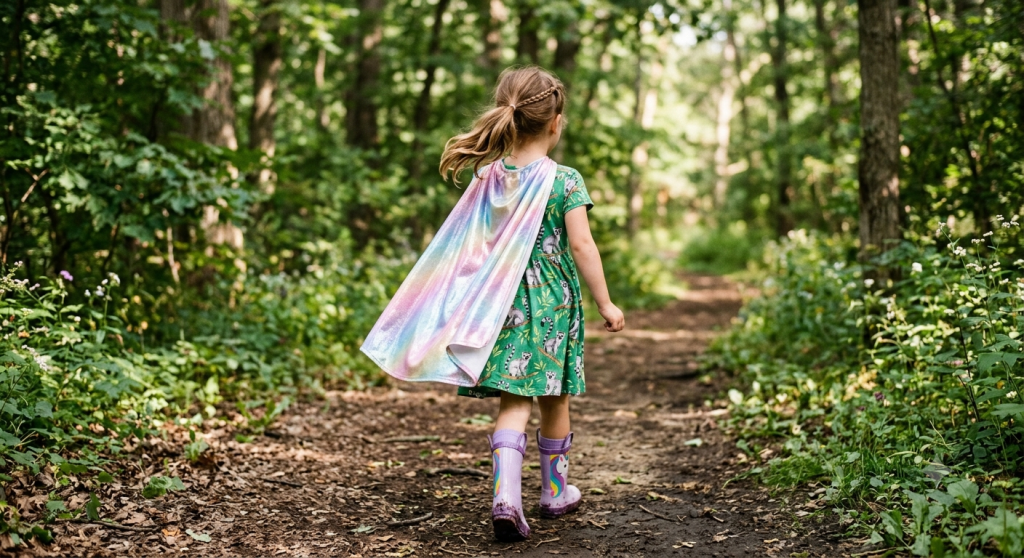
On especially difficult mornings, I let my daughter eat breakfast in her pajamas while riding in our wagon (paid link). This morning, she started our walk wearing unicorn rain boots, a lemur dress, and a sparkly superhero cape. A few streets later and she was running barefoot down the sidewalk, stopping “next to the third tree” while unknowingly practicing prepositions. I’ve learned to pick my battles and let her be comfortable however she chooses. As we walk, we hear birds chirping, feel the wind that blows the trees, and notice the bright colors all around us. Those simple moments help boost our moods before we start the demand of homeschool lessons.
Practicing Prepositions and Listening Skills
One of my favorite ways to teach prepositions is through movement. With my daughter, she loves to run ahead during our walks, so I use that excitement to practice listening and following directions.
Instead of simply telling her where to stop, I change the preposition each time. Some of the directions she hears include:
- Stop on the red sidewalk square.
- Stop before the brown truck.
- Stop next to the third tree.
- Stop at the fire hydrant.
At each checkpoint she’d stop, give me a thumbs-up, and then wait for me to catch up and before I’d give her the next direction.
She absolutely loves this game, and it’s a fun way to strengthen both listening comprehension and language skills. For children with ADHD, combining movement with listening tasks can make learning much more engaging and effective.
Building Math Foundations Outdoors
When my daughter wants an extra challenge, we naturally work math into our walks.
Instead of simple stopping points, I give her directions that require counting, sequencing, or problem-solving, such as:
- Stop at the fifth tree
- Hop 8 times and stop at the mailbox
- Count 6 cars and then stop
The possibilities are endless. We also practice addition, subtraction, skip counting, number recognition, and estimating while we’re outside. It turns an ordinary walk into a hands-on math lesson without it feeling like school.
Using Nature Walks as Social Emotional Learning (SEL)
Our walks don’t just strengthen academic skills- they’ve become one of our favorite ways to build social-emotional learning (SEL).
Self-Awareness
Nature has a calming effect that helps my daughter recognize and understand her emotions. Many mornings she starts our walk feeling frustrated or overwhelmed, but by the end she’ll often apologize for being cranky earlier. Having the space to regulate naturally gives her the opportunity to recognize how her feelings change throughout the morning
Self-Management
Loud noises are still one of my daughter’s biggest sensory challenges. When a bus or large truck drives by, she practices self-management by taking deep breaths, covering her ears or putting on her headphones. Some days go more smoothly than others, but every experience gives her another opportunity to practice coping strategies.
Social-Awareness
My daughter loves greeting everyone we pass. And I mean everyone- she’ll happily shout “Hello!” across the street to complete strangers. One time she even asked a stranger with a suitcase where they were going and why.
Sometimes people wave back and smile. Other times they continue without responding. That used to upset her, but we’ve had many conversations about how they might be having a difficult day, be deep in thought, or simply be shy.
These small moments have become valuable opportunities to build empathy and perspective-taking.
Relationship Skills
Nothing tests my daughter’s relationship skills quite like walking with our neighbors.
She and her best friend are both stubborn, firstborn children with ADHD, so disagreements happen often. Whether they’re debating which direction to walk or what they want to explore next, conflicts naturally arise.
His mom and I help guide those conversations so they learn to listen to each other’s ideas, compromise, and solve problems together.
Responsible Decision-Making
Nature walks also provide countless opportunities to practice responsible decision-making.
My daughter learns to stop and look both ways before crossing the street, stay aware of cars, bikes, and scooters, and make safe choices while exploring our neighborhood. These everyday experiences help build confidence and independence in real-life situations.
Meaningful Learning Opportunities
Our morning walks have become so much more than a way to regulate before homeschool. They’ve become meaningful learning opportunities that naturally combine movement, academics and social-emotional development.
Whether we’re practicing math, strengthening language skills, or working through big emotions, nature gives us the perfect classroom. If you’re looking for simple ways to add movement into your ADHD child’s day, or you’re searching for ways to regulate yourself and your child throughout your homeschool day, outdoor nature walks have so much to offer.

 Neurodivergent Homeschool Life
Leave a comment