Disclosure: As an Amazon Associate, I earn from qualifying purchases. This post contains affiliate links, meaning I may earn a small commission if you buy through them. I only share products our family has used or genuinely believes would be helpful. Thank you for supporting NDHS Life!
Real-Life Experiences
Gardening has always been one of my favorite ways to regulate my emotions and boost my mood. When my daughter started joining me, it quickly became much more than a hobby. Every afternoon in the garden turned into a science lesson—one filled with worms, seeds, insects, math, and plenty of muddy hands. The garden provides so many natural opportunities for learning. Here are just a few of the science topics you can naturally incorporate into your homeschool lessons.
- Observing Insects
- Life cycles
- Ecosystems
- Decomposition
- Plant Anatomy
- Bug Anatomy
- Photosynthesis
- Measurement
- Experimentation
- Hydroponics
Finding Friends in the Dirt: Learning About Garden Bugs
For my daughter, nothing is as fun as digging in the dirt. She absolutely loves to make “rock cities” with the rocks she finds. She also loves finding roly-polies and worms. At one point we even had a roly-poly farm (add that to the list of pets we’ve already had). I used these opportunities to teach her about the different bugs we find in the garden. We learned about the important role worms play in keeping soil healthy. She and her friend both thought it was hysterical when I told them worm poop was the best fertilizer for plants. We also talked about the benefits of roly-polies for our garden, the things they eat, about how they’re nocturnal creatures, and what they do in the winter (they surprisingly hibernate!) She loves learning about all of the bugs in the garden, but she also loves the plants themselves.
Gardening Lessons for Homeschool Science
With plants, we start with lessons from the soil up. We planted our seeds, and my daughter had the daily task of misting them. She also had the job of making sure the wind (or cat) doesn’t knock over the plastic cups we use on top as a humidity dome. She’s always so excited to see little seed sprouts pop up. This was a great time to introduce the things plants need to live, the life cycle of a plant, and different types of soils.
While her little hands were working, it was a perfect time to incorporate some math questions. If she had a handful of seven seeds, I’d ask her to give me two and then figure out how many were left. She also got to practice measuring with a ruler to make sure plants were planted at the ideal depth and spacing. She loved when the plants were ready to harvest and she would frequently pick and eat kale, blueberries and tomatoes.
Hydroponics- But Where’s the Dirt??
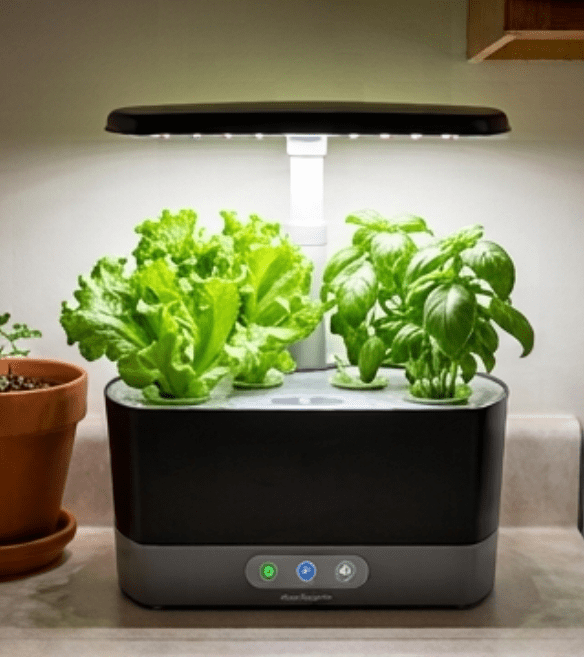
My daughter thought plants needed soil, water, and sunlight to grow. Our first hydroponic garden challenged that idea and opened the door to learning that plants actually need nutrients—not necessarily soil itself. She and I both loved learning about how the roots absorb added nutrients directly from the water. It’s also been fun learning about how the pump helps the roots breathe, ensuring maximum plant growth. We both love picking up the tray top and looking at all of the roots below. She couldn’t believe her eyes seeing how long the roots were for plants that are only 2-3 inches tall.
Gardening for Regulation and Learning
Gardening has been an essential for my regulation, and I’m so glad my daughter is sharing my love for it. It’s provided natural life lessons and skills that she will carry the rest of her life. Gardening has become one of our favorite ways to teach STEM concepts at home because it combines science, math, observation, and problem-solving in a way that feels like play. It’s also helping lower our grocery bill, which I’m sure every parent can appreciate these days.
Here are the tools that make our garden learning a success.
This bug catcher is great (paid link), and my daughter loves filling hers with moss or rocks and then finding bugs to keep in there. She always tries to argue her way out of releasing them at the end of the day.
We have both really enjoyed our hydroponics garden system (paid link). This is also the first time I’ve used one, and I’ve been very impressed with it.
These kids gardening tools (paid link) are a great size for my daughter’s hands. I also know that they’re safer than using really sharp adult tools, and she feels like she’s in control of her own set.
Our mini VegTrug (paid link) has been essential to our learning. While we also have a standard size VegTrug, this mini has been extremely handy providing extra garden space without compromising deck space.

 Neurodivergent Homeschool Life
Leave a comment