Disclosure: As an Amazon Associate, I earn from qualifying purchases. This post contains affiliate links, meaning I may earn a small commission if you buy through them. I only share products our family has used or genuinely believes would be helpful. Thank you for supporting NDHS Life!
Magna-Tiles for STEM Learning
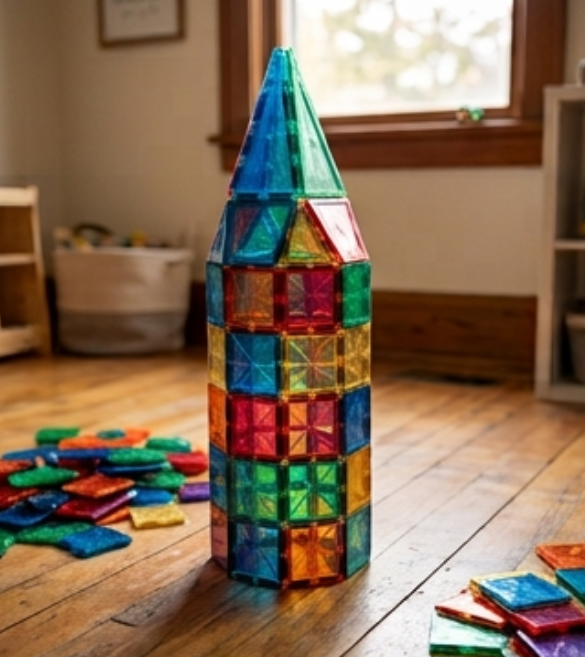
My daughter got her first Magna-tile box when she was 2. I didn’t understand how quickly they would captivate not only my daughter but our whole family. Even the grandparents loved to sit down to build and create when they were in town. I also didn’t realize just how much she would learn from them. Because my daughter has ADHD, these are one of the few toys that consistently keep her attention while letting her move, build, and create. We use both Magna-Tiles and other magnetic tile sets in our house, and they all encourage STEM learning through hands-on play.
Science
My daughter and I had (what I thought) was a good conversation on magnetism and polarity, until I noticed she had a glazed-over look on her face. At that moment I realized I needed to make it more fun and incorporate more movement for her. I kept it simple and told her “opposites attract, each magnet has a north and south pole, take a pile of Magna-Tiles and go find every magnetic item in our house.” She quickly ran around leaving Magna-Tiles behind on every magnetic item. She also turned it into a search-and-find game, where we would take turns hiding the Magna-Tiles on magnetic items for the other to find. She enjoyed this hands-on lesson much more than our original conversation at the table.
Technology & Engineering
One of my favorite things about Magna-Tiles is that it’s actually a technology free activity. I know my daughter often has a hard time pulling away from technology and screens. Even though it’s completely screen-free, she’s still learning the foundations of engineering through planning, testing, and redesigning her creations. Her designs always start out with an idea in her head that she turns it into a physical model. While constructing this model, she’s not only planning and designing what she wants, but she’s also having to problem-solve her way through it. I often hear grunts coming from the living room when her plan isn’t working and her designs aren’t structurally stable, but I encourage her to keep trying. When her builds tumble down, she’s not only building her frustration tolerance but she’s also learning about gravity the hard way.
Math
Math has probably surprised me the most with the endless learning opportunities. Magna-Tiles naturally lend themselves to counting, sorting, patterns, geometry, and even fractions as kids get older. These are some of our favorite ways to use them at different ages:
- Toddler
- Identify colors
- Sort shapes
- Count to five
- Trace shapes on paper
- Cause and effect (gravity and towers falling)
- Pre-K and Kindergarten
- Build 3D puzzle and find the missing shape
- Create patterns (both shapes and colors)
- Count the number of edges in a shape
- Basic addition and subtraction
- Early Elementary
- Explore fractions
- Mirror each other’s builds
- Count the faces, edges, and corners of 3D objects
Our Favorite Magna-Tile Sets
- My daughter loves everything Unicorn, so these unicorn tiles (paid link) are one of her favorites.
- Once my daughter mastered the basic set, these geometry expansion tiles (paid link) became our favorite because they introduced new shapes that made much more detailed buildings possible.
- My daughters builds always have to incorporate doors and windows for all of her animals. These tiles (paid link) were great to give those openings for her to slide her small animals through.
- We’re also huge fans of the Magna-Tile animal sets. These not only encourage pretend play, but also are fun to use to teach habitats. Some of our family’s favorites include:
Quick Learning Activities
- Learn physics through coin drops on the fridge.
- Build car ramps for racing cars.
- Construct a bridge that can hold the most weight (Hot Wheels, Barbies).
- Add letter stickers (paid link) on tiles to spell out and connect words (word families, spelling names, letter matching uppercase to lowercase).
- Use number stickers (paid link) for basic math, counting, and sequencing.
- Practice beginning and ending sounds of tile colors/shape names, followed by spelling out those colors and shapes.
- Tap out syllables by laying down one tile for each syllable in a word.
- Form 2D letters and numbers.
- Practice positional words like above, below, beside, between, inside, and outside while building.
- Take turns giving building directions (“Add a square on top of the triangle.”) to practice listening skills and following multi-step directions.
When we first bought Magna-Tiles, I thought they were just another building toy. Years later, they’re one of the few toys that still gets pulled out almost every day (I’m currently looking at multiple towers on the couch). They’ve helped my daughter explore science concepts, practice math, solve engineering challenges, and most importantly, enjoy learning without realizing she’s doing it. Magna-Tiles have easily been one of the best investments we’ve made, and a great addition to our homeschool low pressure learning toolkit.

 Neurodivergent Homeschool Life
Leave a comment